Tag: money

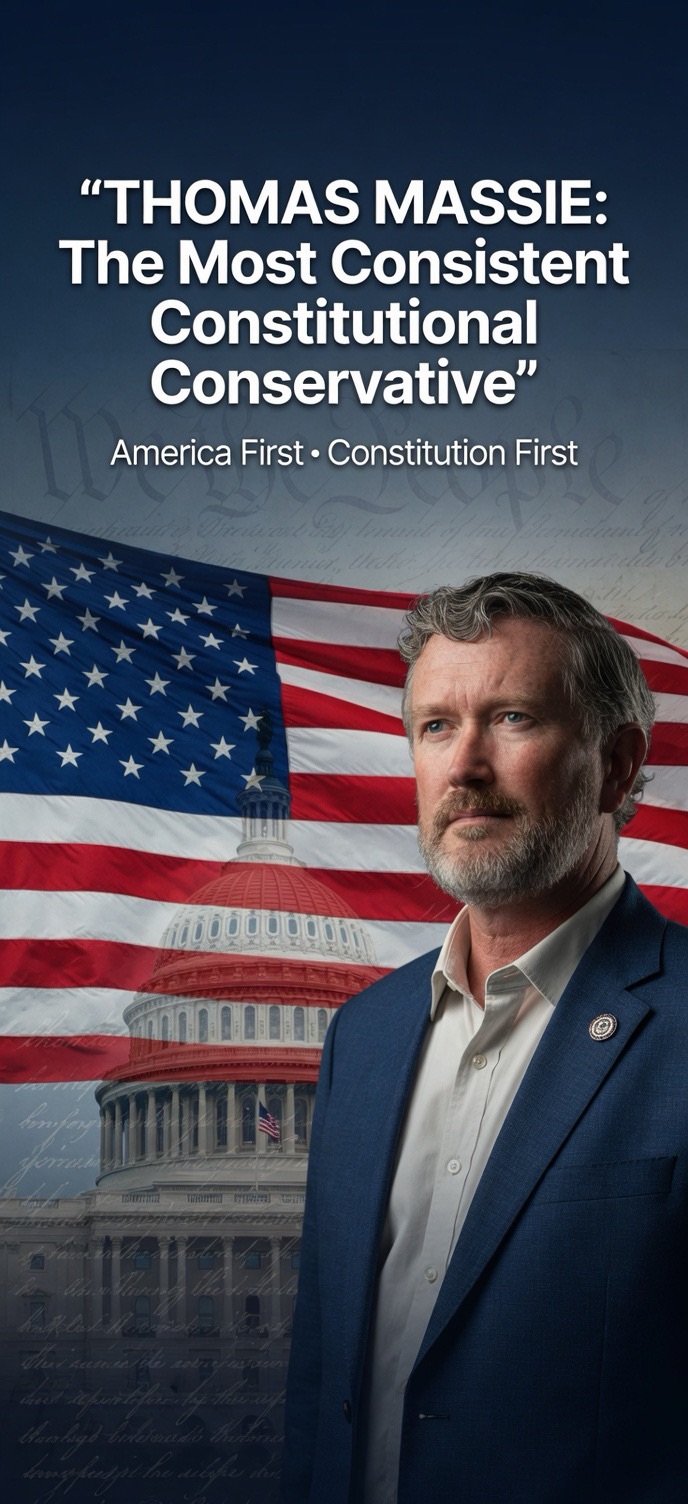
  • Why Thomas Massie Is One of the Most Consistent Constitutional Conservatives in Congress — And Why Kentucky Should Re-Elect Him Today

    Why Thomas Massie Is One of the Most Consistent Constitutional Conservatives in Congress — And Why Kentucky Should Re-Elect Him Today

    By Christian Phillips

    In an era where “conservative” has too often become synonymous with endless foreign spending, unchecked deficits, and loyalty tests over principle, Rep. Thomas Massie stands out as a rare voice of conviction. As Kentucky’s 4th District heads to the polls today in the Republican primary, voters have a clear choice: a proven constitutionalist who puts America and its founding principles first, or a challenger backed by the very forces that have pulled the party away from its limited-government roots.

    Massie isn’t a showman or a party apparatchik. He’s an MIT-educated engineer and inventor who sold his successful technology company before entering public service. In Congress since 2012, he has compiled one of the strongest records of fiscal conservatism, civil liberties defense, and skepticism of forever wars. Organizations like Heritage Action give him a lifetime score around 83% (with sessions often in the 90s), and he frequently ranks near the top on liberty indices from groups like the Club for Growth (92-100% in strong years) and Republican Liberty Caucus.

    America First, Not Endless Foreign Entanglements

    Massie believes in America First as a policy of restraint: secure borders, fiscal sanity at home, and military force only when vital U.S. interests are directly threatened and Congress has declared war. He has repeatedly voted against massive foreign aid packages, unconditional support for overseas conflicts, and surveillance expansions that treat Americans like suspects. This isn’t “isolationism”—it’s constitutionalism. The Founders warned against entangling alliances and standing armies for perpetual conflict.

    He’s taken no money from foreign governments or their lobbies and has pushed for stronger Foreign Agents Registration Act (FARA) enforcement so Americans know who’s influencing policy. Contrast that with the revolving door of foreign influence in Washington. Massie called out corruption and pushed for transparency on files like the Epstein documents—securing their release through bipartisan effort.

    Our country faces $36+ trillion in debt, crumbling infrastructure, border chaos, and domestic struggles. Why send hundreds of billions abroad while veterans wait for care and American families struggle with inflation? Massie asks that question and votes accordingly—often as one of the few “no” votes on bloated omnibus bills.

    Upholding the Constitution Over Party Pressure

    Massie votes with Republicans the vast majority of the time (~90%+), but he breaks ranks when bills balloon the debt, expand executive power, enable warrantless spying on Americans, or commit us to undeclared wars. Examples include opposition to certain surveillance reauthorizations, massive spending packages, and foreign aid without accountability. These aren’t Democratic votes—they’re stands for limited government, exactly what conservatives claimed to champion before the party shifted toward neoconservative interventionism.

    He has sponsored or supported measures to protect family farms from capital gains taxes, promote industrial hemp, rein in federal education overreach, and block warrantless data searches. He’s introduced bills to end funding for foreign abortions and curb executive overreach. This is classical conservatism: individual liberty, constitutional limits, and prudence abroad.

    The Contrast with Lindsey Graham and the Shift in Trump World

    It’s painful for many original Trump supporters to watch. First-term Trump talked tariffs, no new wars, draining the swamp, and putting Americans first. Now we see endorsements of serial hawks like Sen. Lindsey Graham—who spent years calling Trump a “jackass” and pushing regime-change wars, yet now enjoys full Trump backing for reelection while advocating escalations abroad.

    Graham exemplifies the old GOP foreign policy establishment: endless Middle East involvement, more defense spending without restraint, and alliances that often subsidize other nations’ security at U.S. expense. Calling principled restraint “anti-America” while endorsing such figures sends a confusing message. Trump once railed against nation-building and forever wars. Why align with the architects of those policies now?

    Massie has been consistent. He didn’t flip. He represents the non-interventionist, debt-conscious strain that resonated in 2016. Criticizing foreign lobbies’ influence or voting against aid packages that add to our debt isn’t hating America—it’s loving it enough to prioritize its solvency and sovereignty.

    Vote Massie Today for Real Conservatism

    Kentucky’s 4th District deserves a representative who answers to constituents and the Constitution, not donors or party enforcers. This primary has shattered spending records, with massive outside money—much of it tied to pro-Israel and foreign policy hawks—pouring in against Massie.

    That’s telling. The establishment fears an independent voice who won’t rubber-stamp the status quo.

    Thomas Massie protects the Republic by saying “no” when it counts. He fights domestic spying, wasteful spending, and foreign entanglements that weaken us at home. In a Congress full of deal-makers and fundraisers, he’s a constitutionalist doing what the Founders intended: checking power, guarding liberty, and prioritizing the American people.

    Today, vote for the most consistent conservative in the race. Vote Thomas Massie. America needs more like him—not fewer.

  • Taxation is theft!

    The Paradox of Taxation in America

    I’ve never understood how America went from fighting a Revolutionary War over taxation without representation to a system where I’m taxed at every turn. The colonists rebelled against taxes like the Stamp Act and Tea Act, imposed by a distant government without their consent. Yet today, I work hard, and my income gets taxed—federal income tax rates can take up to 37% for top earners, according to the IRS for 2025.

    A Cycle of Endless Taxes

    I take what’s left after income tax, buy something, and face sales taxes—state and local rates combined can hit over 10% in places like California or Tennessee. That same money, already taxed, pays for my property, but then I’m hit with property taxes—averaging 1.1% of a home’s value annually, per the Tax Foundation, and higher in states like New Jersey or Illinois. I call this extortion!

    Our Founding Fathers, like Thomas Jefferson, warned against overreach, saying, “To take from one, because it is thought his own industry… has acquired too much, in order to spare to others, who… have not exercised equal industry and skill, is to violate arbitrarily the first principle of association.” They fought for liberty, not this cycle of endless taxation.

    A Tax Code Out of Control

    The Declaration of Independence lists “imposing Taxes without our Consent” as a grievance, yet today, the federal tax code is over 70,000 pages long. The average American spends 13 hours just filing taxes, per the IRS. We need reform!

    The national debt is over $35 trillion as of 2025, per the U.S. Treasury, and government spending keeps ballooning—$6.5 trillion in federal outlays last year alone, much of it on programs with little accountability.

    Political Failures on Both Sides

    The GOP talks a big game but often fails to cut waste or simplify taxes. Meanwhile, Democrats are obsessed with raising taxes and offer no real help. They push to tax the rich and corporations into oblivion—proposing top income tax rates as high as 39.6%, like in Biden’s early budgets, and floating wealth taxes on billionaires, like Elizabeth Warren’s 2% levy on net worth over $50 million.

    They claim it’s fairness, but France tried a 75% supertax on high earners in 2012, and millionaires fled, tanking investment. The U.S. risks the same—companies like Apple and Tesla already park billions overseas to dodge high taxes, per a 2021 Senate Finance Committee report showing $2.6 trillion in profits stashed abroad.

    The Cost of Tax Hikes

    Democrats’ tax hikes don’t fix anything! They poured $1.9 trillion into the American Rescue Plan in 2021, yet inflation soared to 9.1% by 2022, crushing families, per the Bureau of Labor Statistics. Small businesses got pennies while fraudsters stole billions—$100 billion in pandemic relief was lost to waste and scams, per the Government Accountability Office.

    Instead of cutting red tape or boosting jobs, Democrats double down, pushing corporate tax rates from 21% to 28% or higher, as in Biden’s 2023 budget proposal. The Tax Foundation warned this could cut GDP by 0.2% and kill 27,000 jobs, driving firms to China or Ireland, where rates are 25% or 12.5%. They’d rather tax companies out of the U.S. economy than fix roads, secure borders, or help working families like us!

    The Promise of DOGE

    The GOP must step up! The Department of Government Efficiency (DOGE), launched by President Trump in 2025, has exposed billions in improper payments—$334 million in rejected Treasury requests alone, per DOGE’s April 2025 report, due to missing or invalid budget codes. They’ve suspended payments to 33 providers suspected of fraud at CMS, like billing for dead patients, and cleaned up Social Security, marking 12.3 million records of people aged 120+ as deceased. This is real progress!

    But without laws to lock in these cuts, a future administration could undo it all. The GOP controls the House and Senate—pass the Implementing DOGE Act (H.R. 199) now! Codify these $160 billion in savings, as DOGE claims, and stop career politicians like Susan Collins and Tom Cole from blocking reform. No more excuses—Republicans, fulfill the mandate, protect taxpayers, and make DOGE’s war on waste permanent!

    A Call to Action

    Corruption’s rampant, and I’m not sure we can save this country with this mismanagement. We’re taxed on income, purchases, and property—sometimes the same dollar three times over. Our Founders envisioned limited government, not this. We need a simpler tax code, less waste, and leaders who’ll fight for us, not their own power. Wake up, America—demand change!

    Written by Christian Phillips

  • The Federal Reserve is Unconstitutional and Must Be Abolished!

    Friends, it’s time we talk about something that affects every single one of us: the Federal Reserve. This secretive, unelected institution controls our money, our economy, and, in many ways, our lives. I believe it’s not only unconstitutional but also a danger to our freedom. The Federal Reserve Act of 1913 was a mistake that needs to be undone. Let me explain why, with historical facts to back it up.

    The Constitution Says No to Central Banking The U.S. Constitution is clear about who should control our money. Article I, Section 8, Clause 5 gives Congress the power “to coin Money, regulate the Value thereof, and of foreign Coin.” That’s it. The power to create and manage money belongs to our elected representatives, not a private banking cartel. The Federal Reserve, created in 1913, is a quasi-private institution—a hybrid of government and private bankers—that operates outside the direct control of Congress or the people. This setup violates the Constitution’s explicit delegation of monetary power to Congress.

    The Founding Fathers knew the dangers of central banks. Thomas Jefferson warned, “If the American people ever allow private banks to control the issue of their currency… the banks and corporations that will grow up around them will deprive the people of all property until their children wake up homeless.” James Madison called concentrated banking power “a great evil.” These men fought for a republic where power was accountable to the people, not to unelected elites. The Federal Reserve flips that principle on its head.

    The Shady Origins of the Federal Reserve Act Let’s go back to 1913. The Federal Reserve Act wasn’t passed in the light of day with broad public support. It was crafted in secret by powerful bankers and their political allies. In 1910, a group of banking tycoons—including representatives from J.P. Morgan, Rockefeller, and Warburg—met on Jekyll Island, Georgia, to design a central bank that would protect their interests. They didn’t want a fully government-controlled system; they wanted a bank that gave them influence over the nation’s money supply while shielding them from public scrutiny.

    The result was the Federal Reserve Act, rushed through Congress just before Christmas in 1913 when many lawmakers were absent. President Woodrow Wilson signed it into law, later admitting regret: “I have unwittingly ruined my country.” This wasn’t a democratic triumph—it was a power grab by financial elites.

    Why the Fed is a Problem The Federal Reserve controls the money supply by printing money and setting interest rates, which impacts everything from your grocery bill to your mortgage. But here’s the kicker: it’s not accountable to you or me. The Fed’s Board of Governors and its regional banks include private bankers who prioritize profits over the public good. Since 1913, the dollar has lost over 95% of its purchasing power due to inflation, much of it driven by the Fed’s policies. Meanwhile, the national debt has skyrocketed, partly because the Fed enables deficit spending by buying government bonds with freshly printed money.

    The Fed also fuels inequality. Its policies, like quantitative easing, pump money into financial markets, boosting stock prices and benefiting the wealthy while everyday Americans face rising costs. The Panic of 1907, which bankers used to justify creating the Fed, was itself orchestrated by Wall Street to consolidate power. The Fed didn’t fix economic instability—it institutionalized it.

    Historical Voices Against the Fed I’m not alone in this fight. Throughout history, patriots have opposed central banking. Andrew Jackson, in the 1830s, fought the Second Bank of the United States, a precursor to the Fed, calling it a “den of vipers” and refusing to renew its charter. His victory returned monetary control to the people’s representatives. In the 20th century, Congressman Louis McFadden, who chaired the House Banking Committee, exposed the Fed’s dangers, saying it was “one of the most corrupt institutions the world has ever known.” Even today, figures like Ron Paul have called for auditing and abolishing the Fed, echoing the Founders’ warnings.

    Why Abolish the 1913 Law? Repealing the Federal Reserve Act would restore constitutional authority over money to Congress. It would end the Fed’s ability to manipulate the economy for the benefit of a few. We could return to a sound money system—backed by gold or silver, as the Constitution implies—to stabilize prices and protect savings. Without the Fed, the government would have to live within its means, reducing the debt burden on future generations.

    What Can We Do? This isn’t just history—it’s our future. We need to spread the word, demand accountability, and push our leaders to audit the Fed and repeal the Federal Reserve Act of 1913. Share this post, talk to your friends, and contact your representatives. Let’s take back control of our money and our country.

    Together, we can end this unconstitutional system and build an economy that works for all Americans, not just the elites. Who’s with me?

    Written by -Christian Phillips