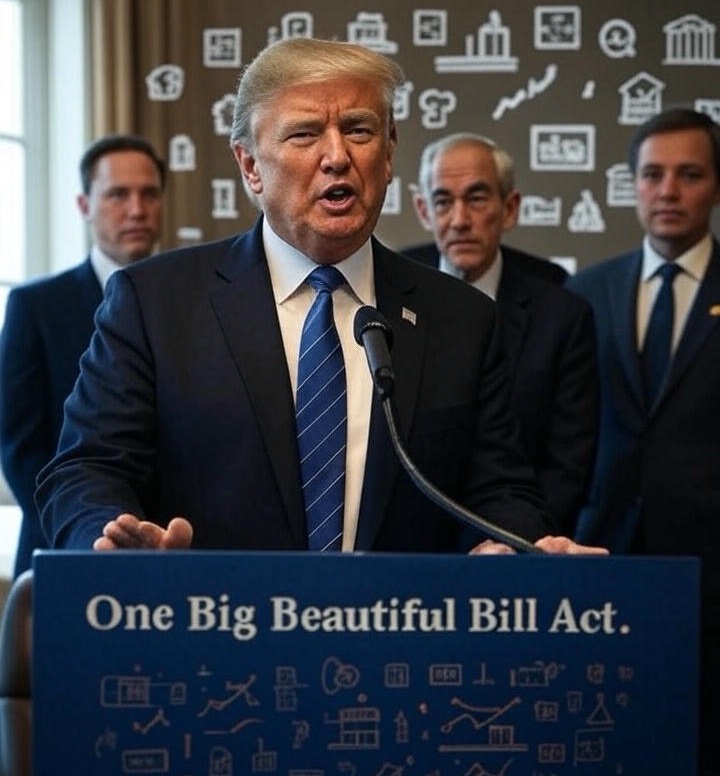
President Donald Trump has thrown his weight behind the “One Big Beautiful Bill Act,” a sweeping reconciliation package touted as a fulfillment of his campaign promises. As of 10:33 AM EDT on Friday, June 6, 2025, this legislation has ignited fierce debate, with Trump and his supporters praising its focus on tax cuts, border security, and welfare reform, while critics—including Elon Musk, Rep. Thomas Massie, and former Rep. Ron Paul—warn of its potential to balloon the national debt and hide wasteful spending. For my blog readers, let’s break down why this bill sounds good in theory but may be a fiscal disaster in practice, exploring Trump’s viewpoint alongside those of Congress and influential voices like Musk, with a closer look at the alarming debt projections if this bill becomes law.
Trump’s Case: Delivering on Promises for America
Donald Trump has framed the One Big Beautiful Bill Act as a cornerstone of his agenda, aiming to deliver on key campaign pledges. The bill is said to focus on three main pillars: cutting taxes, strengthening border security, and reforming welfare programs. For Trump, this legislation is a chance to codify his “America First” policies into law, particularly by supporting small businesses, which he often describes as the backbone of the U.S. economy.
Proponents of the bill highlight its benefits for small business owners, including increasing the small business tax deduction from 20% to 23% and making it permanent, raising the expensing cap for business equipment purchases from $1.25 million to $2.5 million, and ensuring that marginal income tax rate cuts from 2017 remain in place. Additionally, the bill increases estate tax exemptions to $15 million for individuals and $30 million for joint filers, protecting small business owners from hefty taxes when passing their businesses to heirs. These measures are designed to stimulate economic growth and provide relief to millions of small businesses across the country.
Beyond tax cuts, the bill aims to “seal the border” through enhanced security measures and reform welfare programs to reduce dependency and fraud. For Trump and his base, these provisions address long-standing priorities, making the bill a victory for his supporters. Trump likely sees this legislation as a legacy-defining achievement, a bold step to reshape the economy and secure the nation.
Critics in Congress: A Debt Bomb in Disguise
Despite Trump’s enthusiasm, the bill has faced significant pushback from members of Congress, particularly fiscal conservatives who are alarmed by its projected impact on the national debt. Non-partisan analyses from organizations like the Congressional Budget Office (CBO), the Congressional Research Service (CRFB), and the Tax Foundation have estimated that the reconciliation package could add more than $2 trillion to the federal deficit over the next decade if passed, with some projections suggesting it could exceed $3 trillion when accounting for increased debt payments over time.
The CBO’s latest report, released in early June 2025, projects that the bill’s tax cuts and spending measures would increase the federal deficit by approximately $2.1 trillion by 2035, assuming current economic conditions and no significant policy offsets. When factoring in rising interest rates on this new debt—expected to average 3.5% over the next decade—the CRFB estimates an additional $800 billion to $1 trillion in interest payments, pushing the total debt impact closer to $3 trillion. The Tax Foundation further warns that this debt could crowd out private investment, potentially slowing economic growth by 0.5% annually, a cost that would disproportionately affect future generations.
Rep. Thomas Massie, a libertarian-leaning Republican, has likely emerged as a vocal critic of the bill. Known for his staunch opposition to government overreach and excessive spending, Massie would argue that the bill’s tax cuts, while appealing, come at an unsustainable cost. The projected $2–3 trillion debt increase undermines any short-term economic benefits, in his view, and risks saddling future generations with an unmanageable financial burden. Former Rep. Ron Paul, a longtime advocate for fiscal responsibility, would echo this sentiment. Paul has consistently warned against expanding the national debt, and he would likely view this bill as a betrayal of conservative principles, even if it includes popular measures like tax relief.
These concerns from Congress highlight a broader tension: while the bill’s goals may resonate with many Americans, its fiscal implications could have devastating long-term consequences. For Massie, Paul, and their allies, the numbers don’t lie—trillions in new debt signal a reckless approach to governance.
Elon Musk’s Take: A Business Leader’s Red Flags
Elon Musk, the billionaire entrepreneur and a prominent voice in political discourse, has also weighed in on the One Big Beautiful Bill Act. Musk, who has occasionally supported Trump’s policies, is known for his sharp critiques of government inefficiency and wasteful spending. In the context of this bill, Musk would likely acknowledge the theoretical benefits of its tax cuts and small business incentives but argue that they are overshadowed by its fiscal irresponsibility.
Musk has long advocated for reducing the national debt and cutting government waste, often pointing out that billions in federal spending could be eliminated without harming essential services. For him, a bill that adds $2–3 trillion to the deficit is a non-starter, especially with the CBO’s projection of $2.1 trillion in new debt by 2035 and the CRFB’s estimate of up to $3 trillion when interest is included. Higher debt levels could lead to increased interest rates, inflation, and economic instability—factors that directly impact businesses, including Musk’s own ventures like Tesla and SpaceX. Musk would likely argue that the bill fails to address systemic inefficiencies in government spending, making it a risky proposition for the nation’s economic future.
The Hidden Waste: Pork and Spending Run Amok
Supporters of the bill insist that it is free of “pork”—unnecessary or wasteful spending often tucked into large legislative packages. However, critics like Massie, Paul, and Musk are skeptical, pointing to the bill’s massive debt projections as evidence of hidden waste. Reconciliation bills, which can pass with a simple majority in the Senate, are notorious for becoming vehicles for unrelated provisions, pet projects, and earmarks that inflate costs without delivering meaningful benefits.
Potential areas of waste in the One Big Beautiful Bill Act could include:
• Overfunded Border Security: While enhancing border security is a stated goal, the bill may allocate excessive funds to contracts for construction, technology, or personnel—costs that often spiral beyond what’s necessary, as seen in past border initiatives.
• Welfare Reform Expenses: Reforming welfare programs can involve significant transitional costs, such as funding for new administrative systems or temporary subsidies, which may balloon into wasteful spending if not tightly controlled.
• Unrelated Provisions: Large reconciliation packages often include industry-specific subsidies, infrastructure projects, or other measures that don’t align with the bill’s core objectives, adding to its overall cost.
These elements of pork and waste contribute to the bill’s projected $2–3 trillion debt increase, undermining its fiscal credibility. For critics, the bill’s benefits are dwarfed by its long-term costs, making it a risky gamble for the nation’s future.
Good in Theory, Flawed in Execution
On paper, the One Big Beautiful Bill Act has a lot going for it. Its tax cuts and small business incentives could provide much-needed relief to millions of entrepreneurs, fostering economic growth and innovation. The focus on border security and welfare reform addresses pressing issues for many Americans, aligning with Trump’s campaign promises. However, the bill’s execution raises serious concerns. The projected $2.1 trillion in new debt by 2035, potentially rising to $3 trillion with interest payments, poses a significant threat to economic stability, as outlined by the CBO and CRFB. Hidden pork and wasteful spending further erode its credibility as a fiscally responsible piece of legislation.
Conclusion: A Bill That Promises Much but Risks More
The One Big Beautiful Bill Act encapsulates the promise and peril of Trump’s agenda. On one hand, it offers tangible benefits for small businesses and addresses key priorities like border security and welfare reform. On the other hand, its massive debt implications—projected at $2.1–3 trillion over the next decade—and potential for waste have sparked alarm among fiscal conservatives in Congress, as well as influential figures like Elon Musk, Thomas Massie, and Ron Paul.
As the debate over this bill unfolds, Americans are left with a critical question: Is the One Big Beautiful Bill Act a transformative piece of legislation, or a fiscal time bomb waiting to explode? With the CBO projecting a $2.1 trillion deficit increase and the CRFB warning of up to $3 trillion when interest is factored in, the stakes couldn’t be higher. The answer could shape the nation’s economic future—and Trump’s legacy—for decades to come.
Call to Action
I’d love to hear your thoughts, readers! What do you think about the One Big Beautiful Bill Act? Do you see it as a bold step forward for small businesses and border security, or are you concerned about the $2–3 trillion debt projection? Share your insights and perspectives in the comments below—I’m excited to see what you think!
 Constitutional patriot Blog
Leave a comment